






Key Takeaways
- 3-month-old babies need 100% cotton ethnic wear — no silk, no synthetic blends, no unlined embellishments near the skin.
- Angrakha and dhoti kurta sets are the best styles for 3 month baby boy clothes — the wrap-front opening and elasticised bottoms make dressing and diaper changes easy.
- Size up when buying — baby boy clothes 0–3 months run small; a 3–6 month size fits most three-month-olds comfortably and allows better airflow.
- Minimal closures matter most at this age — choose outfits with front buttons or snap closures, not back zips or pull-over necklines.
- A well-chosen ethnic outfit for a 3-month baby boy can be worn for multiple occasions — naming ceremonies, family weddings, first festivals, and milestone photographs.
Your baby is three months old, there is a family function coming up, and everyone wants to see the newest arrival dressed in something traditional and adorable. The challenge is that most ethnic wear for 3 months baby boy looks beautiful online but turns out to be stiff, scratchy, or impossible to put on a wriggly, floppy-necked newborn once it arrives.
At three months, a baby's neck is just beginning to develop control, their skin is at its most sensitive, and they spend most of their time being held, fed, and changed. The 3 month baby boy dress you choose needs to work around all of this — which means soft fabric, thoughtful construction, snap or button closures, and nothing tight or restrictive around the waist or neck.
The good news is that 3 month baby boy clothes in ethnic styles have come a long way. Cotton kurta dhoti sets, angrakha kurtas, and soft printed kurta pyjama sets are now widely available in infant sizing — and when made well, they are both comfortable and genuinely beautiful. This guide covers what to look for, what to avoid, and which specific styles from Pspeaches' baby boy collection are worth considering.
What Makes Ethnic Wear Appropriate for a 3-Month Baby Boy
Not all ethnic wear for 3 months baby boy is created equal. The category is broad — it includes everything from stiff brocade sherwanis (entirely inappropriate at this age) to soft printed cotton kurta sets (perfectly suited for it). What separates the two is fabric, construction, and silhouette.
Fabric is the most important factor. At three months, a baby's skin is still adapting to the outside environment. It is more reactive to heat, friction, and synthetic materials than it will be at six months or a year. The only fabric category that consistently works for baby boy clothes 0–3 months is 100% cotton or soft cotton blends. Cotton breathes, absorbs sweat, does not cause heat rashes, and is gentle enough for daily wear.
Construction matters too. Look for outfits with:
- Front-opening closures (buttons, snaps, or angrakha-style ties) rather than back zips or pull-over necklines
- Elasticised or drawstring waistbands with plenty of room — not tight fitted bottoms
- Smooth inner seams with no rough edges or raw hems
- No hard embellishments (beads, sequins, mirrors) at the neckline or wrist cuffs where they can scratch
Silhouette should be loose. A 3 month baby boy dress in ethnic style should not be structured or fitted. Dhoti sets, kurta pyjamas, and angrakha kurtas all have the loose, flowing construction that works well at this age.
Must Read: How to Dress Your Infant for a Wedding — Ethnic Outfit Ideas for Baby Boys & Girls
The Best Ethnic Outfit Styles for a 3-Month Baby Boy
Angrakha Kurta with Dhoti Pant
The angrakha is one of the oldest and most practical ethnic silhouettes for infants. The wrap-front opening means you never have to pull the kurta over the baby's head — a significant advantage at three months when neck support is still limited. The overlapping front also means the fit adjusts naturally as the baby grows, which gives you a longer useful life out of the outfit.
Paired with a dhoti pant, the angrakha kurta is both traditional and functional. The dhoti's loose, draped construction allows full movement, and an elasticised waist means easy nappy changes without undressing completely.
Shop this look:

A classic white booti print cotton angrakha paired with a matching dhoti pant. The angrakha front opening makes this one of the easiest ethnic wear for 3 months baby boy options to actually put on and take off. White with booti print reads festive without being loud — ideal for naming ceremonies, first pujas, and family functions.
Kurta Dhoti Set
The kurta dhoti combination is the most universally loved 3 month baby boy dress style for Indian celebrations. It is traditional, familiar, and looks effortlessly festive on a newborn being cradled in someone's arms.
For a three-month-old, the key is in the dhoti construction — a proper elasticised dhoti pant (not a tied dhoti that requires wrapping) keeps things manageable. The kurta should have a front button opening and a round or V-neck that does not require lifting over the head.
Shop this look:

A clean white printed cotton kurta with a matching dhoti pant — one of the most versatile pieces in baby boy clothes 0–3 months ethnic range. White is appropriate for any occasion and always photographs beautifully. The printed detailing on the kurta adds interest without fuss.
Kurta Pyjama Set
A kurta pyjama is the simplest and most comfortable 3 month baby boy clothes choice for ethnic wear. The pyjama bottom has a soft elasticised waist, the kurta is straight-cut and loose, and the whole outfit requires minimal effort to put on or take off. It is also the easiest to wash and maintain — which matters when you are doing laundry daily.
For festive occasions, look for kurta pyjama sets in printed cotton or cotton with subtle woven detailing. Solid colours work well too, especially if layered with a light jacket for more formal events.
Shop this look:

A soft blue and white booti print cotton kurta pyjama set — a great everyday ethnic outfit for a 3-month-old. The straight fit kurta sits comfortably on a baby being held, and the soft cotton pyjama bottom has room to breathe. Light enough for warm-weather functions, traditional enough for any celebration.

The A-line cut of this kurta gives it a little more flare at the hem — a relaxed, comfortable silhouette that works well for a baby who spends most of their time lying down or being carried. The booti and stripe combination gives it a layered, textured look that is entirely achieved through print rather than heavy fabric.
Also Check: Cotton vs Silk vs Net — Which Fabric Is Best for Kids Ethnic Wear This Summer?
Kurta Pyjama with Dobby Jacket — For Formal Occasions
When the occasion is a wedding or a large family gathering and you want your baby boy to look properly dressed up, a kurta pyjama set with a lightweight jacket is the right move. The jacket adds a layered, festive finish without adding uncomfortable weight — as long as it is a light dobby or cotton weave rather than heavy velvet or zardozi embellishment.
At three months, a jacket should be an optional layer — something you put on for photographs and the main ceremony, then remove when the baby needs to feed or sleep.
Shop this look:

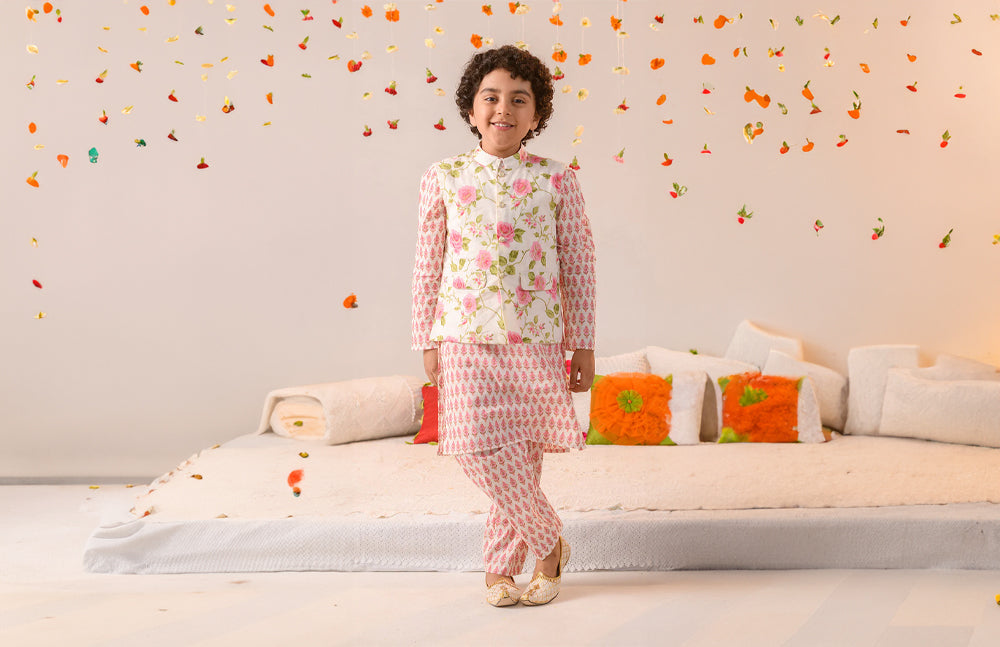
A soft pink cotton kurta pyjama paired with a contrasting green dobby jacket — a vibrant, festive combination that works beautifully for weddings, naming ceremonies, and first festival outfits. The dobby weave jacket adds texture and colour without any of the weight of an embroidered jacket. One of the most striking ethnic wear for 3 months baby boy options for formal functions.
What to Avoid in 3 Month Baby Boy Ethnic Wear
Pull-over necklines. Any kurta that goes on over the head is difficult at three months. Babies at this age have limited neck control, and a tight neckline pulled over the head is uncomfortable and potentially unsafe. Always choose front-opening or wide-neck designs.
Tight fitted bottoms. Churidar-style fitted pyjamas or tight legging bottoms are not appropriate for three-month-olds. The waistband digs in, diaper changes become a two-person job, and movement is restricted. Loose dhoti pyjamas or wide-cut straight pyjamas only.
Heavy embellishments near the face. Any decorative work — mirrors, beads, or zari — that sits within reach of a baby's face is a concern. Babies at three months frequently bring their hands to their faces and mouths, and embellishments on cuffs or necklines can scratch or become a choking hazard.
Polyester and synthetic blends. These do not breathe and cause heat rashes quickly, especially in India's climate. The label should say cotton. If it does not specify, assume it is synthetic.
Structured or shaped silhouettes. A sherwani or bandhgala jacket that holds its shape is shaped by interfacing and padding inside — that structure sits against the baby's skin and is not comfortable. Save shaped ethnic wear for when the child is old enough to walk and move independently.
Sizing: Getting It Right for 3-Month Baby Boy Clothes
Sizing baby boy clothes 0–3 months in ethnic wear requires a slightly different approach than everyday baby clothes.
Standard 0–3 months sizing often runs small in ethnic wear. The silhouettes are traditional and sometimes cut closer than modern babywear. A three-month-old baby who fits comfortably in 0–3 month onesies will frequently need a 3–6 month size in a kurta pyjama or dhoti set to have a comfortable, roomy fit.
Measure the chest and length rather than going by age. At three months, babies vary significantly in size. A chest circumference of 40–44 cm and a body length of 55–62 cm are typical, but check the size chart for each specific outfit.
Room is your friend. A kurta that is one size too large looks perfectly fine on a baby — the silhouette is traditionally loose anyway. A kurta that is too small looks tight and is uncomfortable. Always err on the side of the larger size.
Factor in diaper bulk. Diapered bottoms add approximately 2–3 cm around the waist. An outfit that fits the waist measurement exactly will be too tight in practice. Look for soft elastics with visible stretch room when the waistband is at rest.
Occasions for Ethnic Wear at 3 Months
Naming ceremony (Naamkaran): This is the occasion most parents first dress their baby in ethnic wear. A white or cream kurta dhoti set, an angrakha in soft printed cotton, or a festive kurta pyjama in a traditional colour like yellow, green, or red are all ideal. The outfit will be in photographs for life.
First family wedding: A festive 3 month baby boy dress for a wedding should balance looking dressed up with being practical through a long day. A kurta pyjama with a dobby jacket gives you that dressed-up look while keeping the baby comfortable.
First Diwali or festival: For a first Diwali or Puja at home, a simple printed cotton kurta pyjama is perfect. It does not need to be elaborate — the moment itself carries all the significance.
Milestone photographs: Three-month photos are a big deal for most families. An ethnic outfit gives the photographs a timeless quality. A clean white angrakha dhoti set or a vibrant blue printed kurta pyjama both photograph beautifully.
Caring for Baby Boy Ethnic Wear
Cotton ethnic wear is, thankfully, low-maintenance compared to silk or embellished pieces.
Pre-wash before first wear. Cotton may have residual dye or fabric finish from manufacturing. A gentle pre-wash softens the fabric and removes any surface irritants before it goes on your baby's skin.
Hand wash or gentle machine cycle. Use a mild, baby-safe detergent. Avoid harsh detergents or fabric softeners with strong fragrance for newborn clothing.
Dry in shade, not direct sun. Direct sunlight fades printed cotton quickly, especially the vibrant block prints used in traditional ethnic wear. Shade drying preserves the colours through multiple washes.
Iron inside out. Most printed cotton ethnic wear should be ironed on the reverse side to preserve the print and avoid shine from direct heat contact.
Store folded, not hung. Cotton ethnic wear for infants is light enough that hanging can pull the shape. Fold and store flat.
Conclusion
Finding the right ethnic wear for 3 months baby boy is about understanding what a newborn actually needs — soft cotton fabric, easy openings, generous sizing, and loose silhouettes — and then finding pieces that deliver all of that while still looking festive and traditional. Angrakha dhoti sets, printed kurta pyjamas, and cotton kurta dhoti sets are the styles that consistently work best at this age.
The best 3 month baby boy dress is the one your baby wears comfortably through the whole occasion — not the one that looks impressive for the first twenty minutes and then comes off because he is fussy. When you start with fabric and fit, the rest follows naturally. Browse Pspeaches' full baby boy ethnic wear collection to find cotton-first, infant-ready pieces that actually work at three months.
Frequently Asked Questions
1. What is the best ethnic wear for a 3-month baby boy?
The best ethnic wear for a 3 month baby boy is a soft 100% cotton kurta dhoti set or angrakha kurta with dhoti pant. These styles have front-opening or wrap closures that do not require pulling over the baby's head, loose bottoms for easy diaper access, and breathable fabric that is gentle on newborn skin.
2. What size should I buy for baby boy clothes 0–3 months in ethnic wear?
When buying baby boy clothes 0–3 months in ethnic styles, size up to 3–6 months. Ethnic wear silhouettes are traditionally cut closer than everyday babywear, and the extra room allows for better airflow and more comfortable movement. Always check the brand's chest and body length measurements.
3. Can a 3-month-old baby boy wear a kurta pyjama to a wedding?
A soft cotton kurta pyjama set is one of the best 3 month baby boy clothes choices for a wedding. For a more formal look, add a lightweight dobby jacket for the ceremony and photographs, then remove it when the baby needs to feed or sleep.
4. Which fabric is safest for a 3 month baby boy dress?
100% cotton is the only fabric recommended for a 3 month baby boy dress. It breathes well in India's climate, does not cause heat rashes, and is gentle on sensitive newborn skin. Avoid polyester, synthetic satin, heavy silk, and unlined fabrics of any kind.
5. What should I avoid when choosing ethnic wear for a 3-month baby boy?
Avoid pull-over necklines, tight fitted bottoms, embellishments near the face or neck, synthetic fabrics, and structured silhouettes like padded sherwanis. At three months, the priority is always softness, easy dressing, and loose fits that accommodate diaper bulk.
6. How do I care for cotton ethnic wear for a newborn?
Pre-wash before first use, hand wash or use a gentle machine cycle with baby-safe detergent, dry in shade to preserve print colours, and iron inside out. Avoid fabric softeners with heavy fragrance for newborn clothing.
Shop the full range of ethnic wear for baby boys at Pspeaches — soft cotton, infant-friendly sizing, festive ready.