






Key Takeaways
- A lehenga choli is the more formal choice — best for weddings, receptions, and photograph-heavy occasions.
- A girls sharara set is more comfortable for active wear — wider leg construction means easier movement for younger girls and longer events.
- Age matters — lehengas work well from around age 4 upward; shararas suit toddlers onward due to their relaxed silhouette.
- For summer functions, a sharara for girls beats a heavy lehenga — less fabric, more airflow, same festive appeal.
- Both styles can be dressed up or down — fabric, embellishment level, and colour do more work than the silhouette alone.
Every time there is a wedding, a festival, or a family function on the calendar, the same question comes up: lehenga or sharara? Both are traditional, both photograph beautifully, and both come in enough colours and prints to suit any occasion. But they are not interchangeable, and choosing the wrong one for the wrong event — or the wrong age — makes a noticeable difference in how comfortable and confident your daughter actually feels wearing it.
A lehenga choli for girls is the classic, formal choice. It has a certain weight and presence to it that works brilliantly for big occasions. A girls sharara set, on the other hand, is more relaxed in silhouette, easier to move in, and often more practical for younger children or events that run long.
This guide breaks down the real differences between the two — in terms of comfort, occasion-suitability, age-appropriateness, fabric, and styling — so you can make the right call the next time you are shopping ethnic wear for girls. No vague advice, no unnecessary comparisons. Just what you need to know.
What Is a Lehenga Choli — and What Makes It Work
A lehenga choli is a three-piece outfit: a fitted or semi-fitted blouse (the choli), a flared skirt (the lehenga), and a dupatta. The silhouette is defined by the volume of the skirt — the more layers and the wider the flare, the more formal and occasion-ready the outfit looks.
Lehenga choli for girls works because it has a timeless festive quality. The full skirt photographs beautifully, the structured choli gives the outfit a polished finish, and the dupatta adds a traditional layer that makes it feel occasion-appropriate even without heavy jewellery.
The tradeoff is practicality. A full lehenga has multiple layers, which means more heat in summer and more restriction in movement for a child who wants to run, sit on the floor, or dance freely. The choli is also fitted, which means sizing needs to be accurate — a choli that is even slightly tight will be uncomfortable quickly.
Lehenga choli works best for:
- Formal weddings and receptions
- Evening functions where the outfit needs to stand out
- Milestone celebrations and photograph-heavy occasions
- Girls aged 4 and above who can manage the full silhouette comfortably
Must Read: Cotton vs Silk vs Net — Which Fabric Is Best for Kids Ethnic Wear This Summer?
Shop: Lehenga Choli for Girls

A tiered lehenga in a vibrant patola print — one of the most versatile picks in the lehenga choli for girls range. The tiered construction gives the skirt volume without the stiffness of a heavily lined lehenga, and the patola print is traditional enough for weddings and festive enough for Navratri or Diwali. Great for girls who want full movement without a rigid silhouette.

A warm orange tiered lehenga choli with dupatta — a statement colour that works beautifully for mehendi functions, Diwali, and autumn weddings. The tiered skirt adds movement and flare, and the orange tone photographs exceptionally well in natural light. A strong choice for girls who love colour.

A black lehenga choli with mirror embellishment — one of the more sophisticated picks in the range, and an excellent option as a lehenga for teenage girl who wants something that reads more grown-up and less conventionally "little girl." The mirror work catches the light without needing additional accessories, and black makes it appropriate for evening receptions and formal functions.

A beautifully detailed lehenga choli with lotus patchwork — handcrafted detailing that makes it genuinely special for milestone occasions. The lotus patch design is intricate enough to look occasion-ready without being overdone. A lovely pick for a first big wedding or a family ceremony where the photographs will last.
What Is a Girls Sharara Set — and What Makes It Different
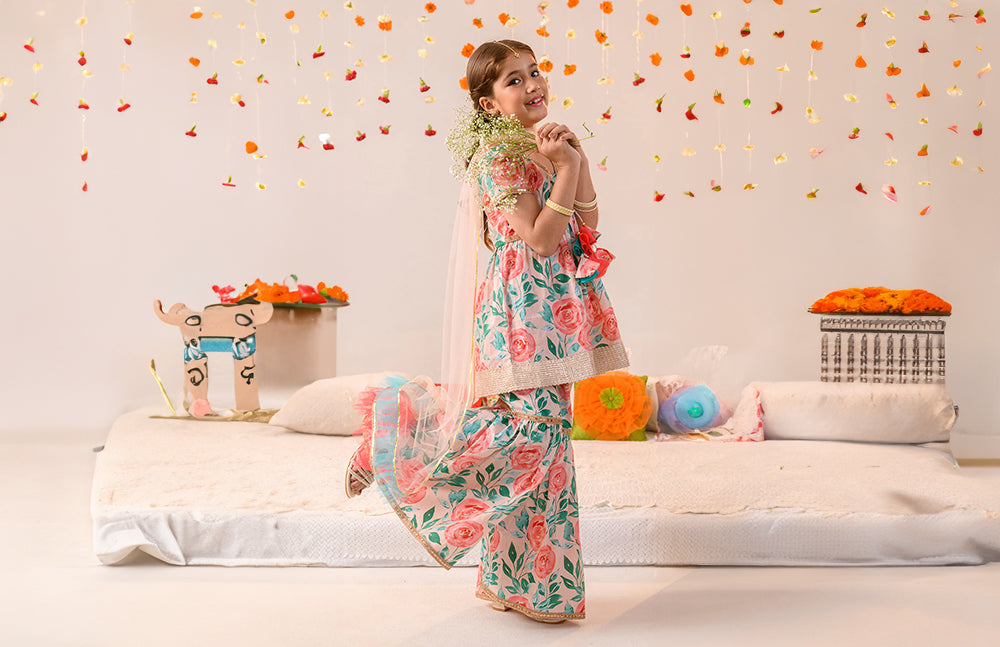
A sharara is a wide-legged divided skirt — it looks like a full skirt when standing but functions as palazzo-style trousers when moving. Paired with a kurta or short top and a dupatta, a girls sharara set has all the traditional presence of a lehenga without the restriction of a full skirt.
The key difference is in what happens when your daughter moves. In a lehenga, movement causes the skirt to sway and lift — beautiful, but limiting when she wants to sit on the floor, climb onto a chair, or dance without thinking about it. In a sharara, she has full leg freedom because it is technically trousers, regardless of how it looks from a distance.
This makes sharara for girls a particularly smart choice for:
- Younger girls (age 3–8) who need full movement
- Long events where comfort across several hours matters
- Summer functions where lighter fabric and less layering is a priority
- Girls who are more active and less likely to want to manage a long skirt all day
The kurta top in a sharara set also tends to be more comfortable than a fitted choli — it sits looser on the body, does not require as precise a fit, and is easier to eat and move in.
Also Check: How to Dress Your Infant for a Wedding — Ethnic Outfit Ideas for Baby Boys & Girls
Shop: Sharara Sets for Girls

A green thread work kurta sharara set with dupatta — one of the most complete girls sharara set options for festive occasions. The thread work on the kurta adds embellishment without making the outfit heavy, and the green is a natural choice for Diwali, Teej, and spring wedding functions. Classic, well-finished, and comfortable for a full day of celebration.

The purple thread work variant of the same set — a richer, cooler tone that works particularly well for evening functions and indoor weddings. Purple is a strong colour on most skin tones and photographs well under both artificial and natural lighting. A reliable sharara for girls pick when you want something festive but not overwhelming.

An off-white georgette sharara set with sequin embellishment and ethnic motif print — one of the most elegant picks in the range and a strong option as ethnic wear for girls for formal occasions like receptions or sangeet nights. Georgette fabric gives it a flowing, light quality that is far more comfortable in warm weather than a full silk lehenga, while the sequins ensure it reads occasion-appropriate.

A yellow angrakha-style kurta with embroidered motifs paired with a sharara and dupatta — a standout piece that combines the traditional angrakha silhouette with the practicality of a girls sharara set. Yellow is a natural fit for Haldi, Vasant Panchami, and spring weddings, and the angrakha front adds a heritage quality that sets it apart from standard kurta-sharara combinations.
Sharara vs Lehenga: A Direct Comparison
| Feature | Lehenga Choli | Girls Sharara Set |
|---|---|---|
| Formality level | Higher | Moderate to high |
| Movement | Restricted | Free |
| Comfort for long events | Moderate | High |
| Best age group | 4 years and above | 3 years and above |
| Summer suitability | Moderate | Better |
| Ease of dressing | Moderate | Easy |
| Photograph impact | Very high | High |
| Dupatta management | Required | Optional |
| Diaper/toilet access | Difficult | Easy |
| Best occasion | Weddings, receptions | Weddings, festivals, functions |
Choosing by Occasion: When to Pick Which
Big, formal wedding (baraat, ceremony, reception):
A lehenga choli for girls is the right call here. The occasion demands a certain presence, and a full lehenga delivers that in a way a sharara simply does not in a formal setting. Go for one with a tiered skirt or structured flare, and choose an embellishment level that matches the event — heavier embroidery for evening events, lighter prints for daytime.
Mehendi or sangeet:
Either works here, but a girls sharara set often makes more sense. These are longer, more active functions where children are dancing, sitting on the floor, and moving around freely. A sharara gives them the freedom to do all of that without managing a long skirt. A colourful thread work or sequinned sharara set looks festive enough for both functions.
Diwali or festive puja:
A sharara set is the easier and more comfortable pick. These are often multi-hour home celebrations that involve sitting, eating, and interacting across different spaces. The kurta-sharara combination is comfortable enough to wear all evening without complaint. Go for rich festival colours — green, yellow, purple, orange.
School cultural programme or children's function:
A sharara set wins clearly here. Girls need to move freely during performances, and a sharara for girls in a comfortable fabric makes that possible. A lehenga is too impractical for stage programmes or school events.
Teenage girl for a formal wedding:
A lehenga for teenage girl is the stronger choice at this age because older girls are generally more comfortable managing a full lehenga silhouette, and the occasion calls for a more polished look. A black mirror work lehenga or a heavily embellished tiered design reads age-appropriate and occasion-appropriate at the same time.
Choosing by Age: What Works at Each Stage
Ages 2–4 (toddlers):
Sharara, without question. At this age, children need full movement, regular toilet breaks, and an outfit that does not require constant adjustment. A wide-leg sharara with an elasticised waist is practical and looks adorable. A lehenga at this age is usually more effort than it is worth for anyone involved.
Ages 4–7:
Both work, but the sharara remains more practical for active or younger girls in this range. If the occasion is a large formal wedding with photographs, a lehenga choli is appropriate. For any other function, a sharara set is more comfortable and easier to manage.
Ages 7–12:
Girls in this age group can comfortably manage a full lehenga for formal occasions. This is also the age where the choice starts to involve the child's own preference — some girls at this age love the full skirt of a lehenga; others find it uncomfortable. Ask before deciding.
Ages 12 and above (teenage):
A lehenga for teenage girl becomes a genuinely great option here. Older girls can manage the silhouette, appreciate the formality, and often prefer the way a full lehenga looks for big occasions. That said, a well-chosen sharara set — especially in georgette or with heavier embellishment — still works beautifully for less formal events.
Fabric Guide: What to Look for in Each Style
For lehenga choli:
Cotton-blend or georgette lehengas work best in summer. Silk or brocade is appropriate for cooler months or air-conditioned evening venues. Always check the inner lining — the skirt lining should be soft, full-coverage, and not scratchy. Net overlayers should be fully lined.
For sharara sets:
Georgette is the best fabric for a girls sharara set at a festive occasion — it flows beautifully, is lighter than silk, and breathes well. Cotton shararas are excellent for daytime or summer functions. Avoid stiff polyester-heavy sharara sets — they do not drape properly and are uncomfortable in warm weather.
For both styles, check:
- Waistband elasticity and softness
- Inner lining quality on embellished sections
- Seam finishing on the inside of the garment
- Dupatta weight — a heavy dupatta on a young child is more burden than accessory
Styling Tips: Getting the Most Out of Both Outfits
For a lehenga choli:
Keep accessories simple if the lehenga is heavily embellished. A pair of jhumkas and a braid with flowers does more than a full jewellery set on a child. Let the outfit do the work. For a tiered print lehenga, you can add a little more colour in accessories.
For a sharara set:
The kurta top in a sharara set gives you more styling flexibility than a fitted choli. A longer kurta can be styled with the dupatta draped at the front; a shorter one with the dupatta across the shoulder. Both read traditional and festive. Kolhapuris or mojris work well with either style.
Dupatta management for younger girls:
For girls under 6, consider pinning the dupatta lightly to the shoulder of the kurta or choli rather than leaving it loose. This keeps it in place, keeps it out of the food, and means you are not re-draping it every ten minutes.
Conclusion
The choice between a girls sharara set and a lehenga choli for girls comes down to the occasion, your daughter's age, and how long she needs to wear the outfit. A lehenga is the more formal, photograph-ready choice — it suits big weddings and reception nights where presence matters. A sharara is the more practical, comfortable choice — it suits active girls, longer functions, summer weather, and younger children who need full movement.
Neither is universally better. The best outfit is the one your daughter actually wants to wear, can move in comfortably, and suits the specific occasion you are dressing her for. Start with the event and the age, and the right silhouette will follow. Browse Pspeaches' full range of ethnic wear for girls — including lehenga choli and sharara sets — to find the right fit for your next occasion.
Frequently Asked Questions
1. Which is better for a young girl — a sharara set or a lehenga choli?
For younger girls (ages 2–6), a girls sharara set is generally more practical because of the full leg freedom, easier toilet access, and comfortable kurta top. A lehenga choli for girls is better suited for formal occasions and older girls who can comfortably manage the full skirt silhouette.
2. What is the difference between a sharara and a lehenga?
A lehenga is a full flared skirt worn with a fitted choli and dupatta. A sharara is a wide-legged divided skirt that resembles a full skirt when standing but functions as trousers when moving. The sharara offers more freedom of movement while the lehenga has a more formal, structured appearance.
3. Which ethnic wear is best for a teenage girl — sharara or lehenga?
For a lehenga for teenage girl attending a formal wedding or reception, a full lehenga choli is the stronger choice. For festivals, sangeet nights, or less formal functions, a well-embellished georgette sharara set works equally well and is more comfortable across a longer event.
4. What fabric is best for a girls sharara set in summer?
Georgette and cotton are the best fabrics for a sharara for girls in summer. Georgette flows well, is lighter than silk, and suits festive occasions. Cotton works for daytime and outdoor functions. Avoid heavy polyester or stiff synthetic blends in warm weather.
5. Can a sharara set look as formal as a lehenga choli?
A heavily embellished girls sharara set in georgette or silk blend — with sequin work, embroidery, or detailed threadwork — can absolutely read as formal as a lehenga for most occasions. The exception is very large weddings or receptions where a full lehenga is clearly the expected silhouette.
6. What age is appropriate for a lehenga choli for girls?
A lehenga choli for girls works well from around age 4 upward. Below that age, the fitted choli and managed dupatta make it impractical. From age 7 onward, most girls can comfortably handle the full lehenga silhouette for formal occasions.
Explore Pspeaches' full collection of girls sharara sets and lehenga choli for girls — traditional styles, thoughtful construction, built for real celebrations.